Ambajidurga is a granite hillock near Chintamani that rises above 4,399 ft above sea level. The hill is characterised by very little vegetation — it is barren and rocky, with bushes, grass and a few thorny, small trees.
The terrain is rocky — boulders, stone steps taking you atop the summit.
The climb atop is full of surprises — some because of its colourful flowers that pop out unexpectedly, adding a tinge of colour to the barren rocky landscape. Or the shining black mica, reddish ferrous rocks that greet you as you climb the stone steps.
The hillock is full of mysteries.
No one knows who built the fort or the temple atop. Yet there are a few predictions and probabilities, making the hillock and its ruined fort a mystery for visitors.
Getting to Ambajidurga
Ambajidurga is 2–3 hours from the city of Bangalore. The hillock is in the same direction as Kalishagiri Cave Temple. You cross over Kalishagiri Cave Temple to reach Ambajidurga.
The trek has two approaches.
One is an 8 km terrain that can be done from Upparpet village. The other is a shorter, 1-hour trek that starts from the Hanuman temple midway up the hill.
Bikes and cars can be driven from the base of the hill to this Hanuman temple point. From here, you can climb the hill.
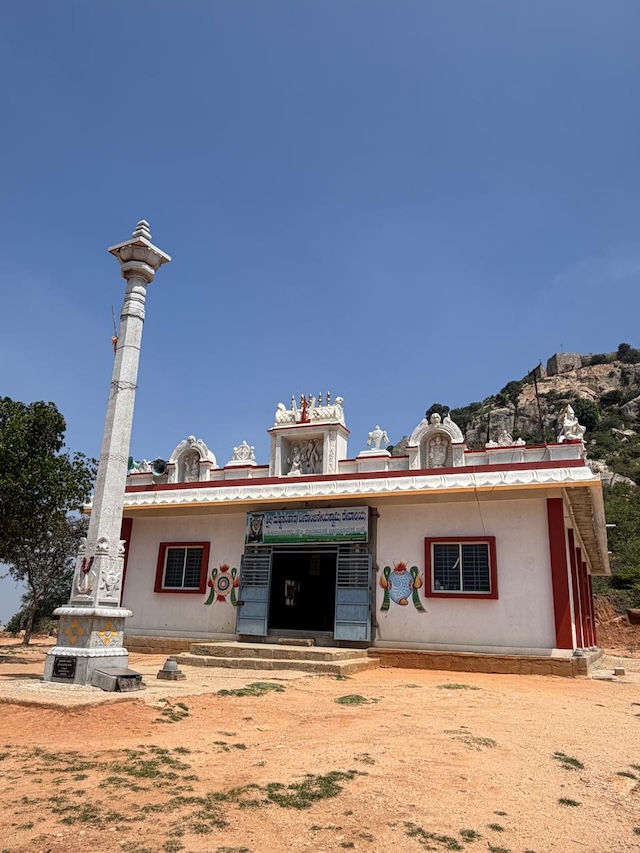
Vira Anjaneya
This temple, according to the signboards, is 1,700 years old. The board further states that it is the temple of Vira Anjaneya.
And as if to show Hanuman in combat, you see the statue of Hanuman with a demon beneath his feet.
It was in pitiful condition a few years back and, with the help of a few well-wishers, today it wears a decent look.
The idol is beautiful, showing Hanuman with one hand raised in a blessing pose.
The Temple of Durga
From here, you start climbing, only to get another temple of Durga.
She is actually a ferocious form of Durga — Mahakali with skulls — but here she is in a seated form, earning the title Durga.
A conversation with the local priest revealed this fact.
A quick darshana here and then you begin the climb.
The Ambajidurga Fort
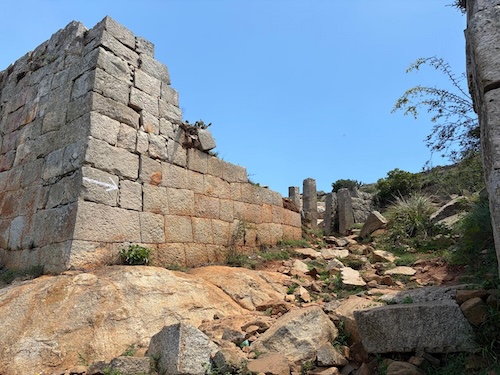 This is the entrance gateway of the Ambajidurga fort.
Who built this fort is unknown.
An early account attributes the fortification to Tipu Sultan, while a later historical study attributes a fort on Ambaji Durga to the Maratha chiefs Chintamani Rao and Ambaji Rao.
Whether Tipu built a new fort or strengthened an earlier one remains unclear.
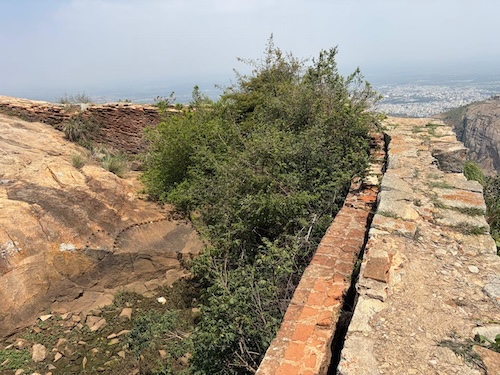
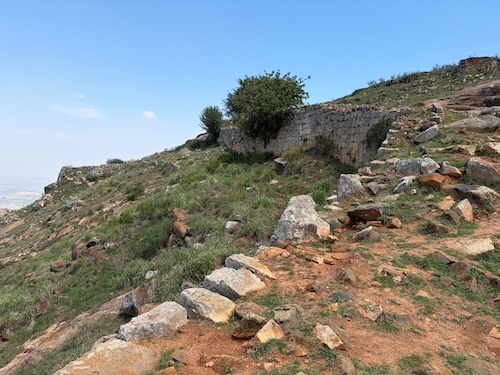 The fort has three encircled fort walls. The fort walls are in ruins today.
The bastions exist — some are circular domes and some are said to be square ones.
 There is a water reservoir — it is in a dried-up condition.
In 1791, the fort was captured by Lord Cornwallis from Tipu Sultan. Local accounts say that the fort was subsequently destroyed.
The Temple Atop the Hill
Atop the hill there is a Shiva temple.
The doorway has bodyguards of Shiva, and atop the ceiling there are images of fish and snake.
A Nagari script in the inner sanctum, however, mentions Laxminarayana Namaha, signifying the sanctum perhaps had the idol of Vishnu — not sure, or perhaps the stone was brought from some other place.
One paper tentatively attributes the temple to an unknown chieftain during the reign of the Avathi rulers, but I have not found enough evidence to establish this.
The History Around Ambajidurga
The political history of the surrounding Kolar region gives us some context.
Kolar was the capital of the Gangas. Then it was ruled by many dynasties, from the Banas, Cholas and Hoysalas to Vijayanagara.
During the 15th century, it was ruled by Timmegowda, mentions a 2011 Kolar Gazetteer.
In 1639, Kolar went into the hands of Bijapur, then 20 years later to the Mughals.
In 1720, Hyder Ali’s father was the fauzdaar of this place, and in 1761, Hyder Ali commanded the place.
In 1770, the fort was also captured by Maratha rulers, and sometime later it came into the hands of Tipu Sultan, who fortified the fort.
In 1791, during the Third Anglo-Mysore War, it fell into the hands of Lord Cornwallis.
So whether the Ambaji Durga temple below or the Shiva temple above was built during the reign of the Avathi rulers or the Marathas is unsure.
The Powder Magazine
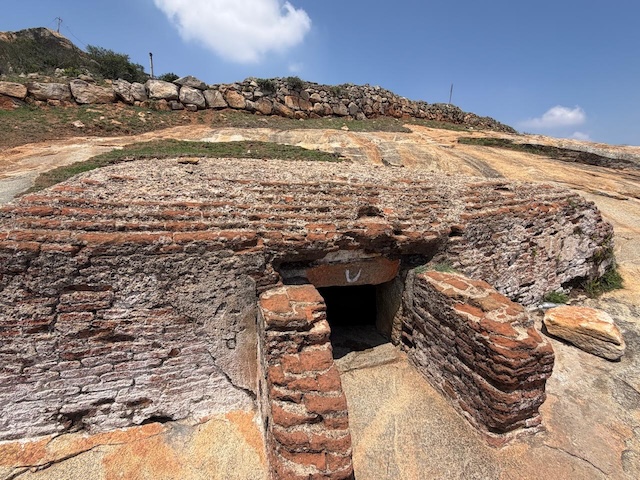 Behind the temple there is a powder magazine.
Today it is an underground well with water.
As the rains were low, the water has receded below and cannot be reached.