The Gangas: Reliving History at Lalbagh
When I look out from my apartment at the land surrounding me, I sometimes wonder who stood here before me. Not twenty or thirty years ago, but centuries ago. Who lived here? Who ruled this piece of land? Did a king, a chieftain, a local ruler or an ordinary farmer once look at this very landscape?
This is not some bizarre thought, though. Because Karnataka, you see, has been a home ground for many ancient dynasties.
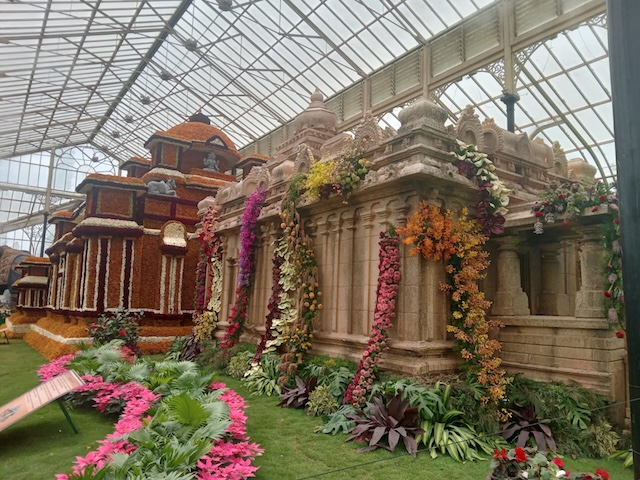
One of the dynasties, the Western Gangas, ruled this region right from the 4th century to around the 10th century. These were native rulers who ruled the southern and central parts of Karnataka and, in their heyday, occupied some parts of northern Tamil Nadu as well. Along with the Kadambas, who ruled much of the northern part of Karnataka, these were among the earliest Kannada dynasties to establish their sway here.
There were various rulers—some famous and some not so much. The founder of this kingdom was Kongunivarma, who established the capital at Kolar. Following him were his successors Madhava I, Harivarma, Madhava II, Madhava III, Avinita, Durvinita and others. Through political alliances and marriages, including ties with the Kadamba lineage, the Gangas gradually strengthened their position in the region. During the reign of Madhava I, the capital was shifted from Kolar to Talakad, on the banks of the Kaveri.
Their contemporaries were the Rashtrakutas, Chalukyas and Pallavas. Battles for supremacy, struggles for territory and attempts to extend boundaries were the norm. The Gangas sometimes aligned themselves with the Pallavas, sometimes with the Rashtrakutas and even with regional rulers like the Nolambas.
The region we now call Karnataka must have been quite a happening place some 1,200 years ago.
Some of the famous rulers of this dynasty, such as Sripurusha, Butuga II, Rachamalla I, Rachamalla II and Marasimha II, are worth remembering. Sripurusha’s reign was known as Srirajya, reflecting the prosperity and importance of his rule.
These kings were not just great soldiers; they were scholars too. For example, Sripurusha is credited with a treatise on taming and training wild elephants known as the Gajashastra.
Chavundaraya, a minister, was also extremely important. He was a Ganga general and minister and is best known for commissioning the monumental Gommateshwara statue at Shravanabelagola.
Butuga II allied himself with the Rashtrakuta king Amoghavarsha III and is particularly famous for his role in the defeat of the Chola ruler Rajaditya at the Battle of Takkolam.
The last ruler of this dynasty was Rachamalla IV.
The Queens Were No Less
The queens too were no less significant. Some of them administered the capital when the king was absent and also looked after various departments such as trade, agriculture and commerce.
One of the queens of Sripurusha, Kanchiyabbe, gave land grants for shrines and promoted educational institutions. Another queen, Vinayavati, was engaged in agriculture and was noted for regulations such as one stating that bullocks should not be made to work continuously for twenty days.
How Do We Know All This?
How do we know all this about people who lived more than a thousand years ago?
Through the traces they left behind—memorial stones, inscriptions, literature, temples, sculptures and monuments. Each of these gives us a glimpse into a world that would otherwise have disappeared.
And this year, at the Lalbagh Flower Show, that distant world was brought surprisingly close.
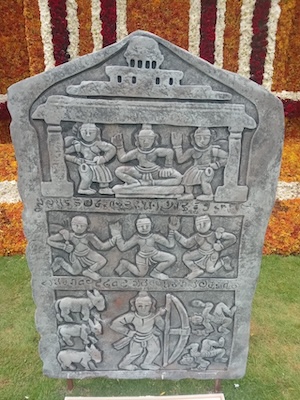
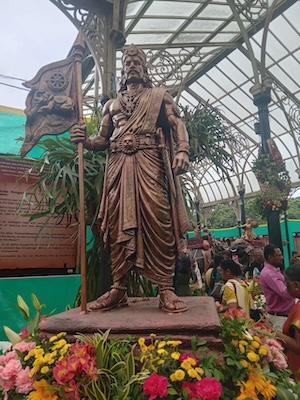
Through visual props, statues, replicas of memorial stones and inscriptions, the history of the Gangas was recreated for visitors to see. Instead of simply reading about a dynasty that ruled Karnataka centuries ago, we could actually see fragments of the world they inhabited.
Isn’t that a fun way to relive history?